English Language & Grammar
СтатистикаA channel for all the English-learners around the World 🌎 Buy Ads: @CaptainJamesCook Second channel: @french
- Последний пост
- 11:56
- Последнее чтение
- 09:14
- Постов за неделю
- 16
- Всего постов
- 26
- Тип
- открытый
- Язык
- английский
- Категория
- Языки
- В каталоге с
- 13 авг.
- 1/24сутки в ленте
- 2 350
- 1/48двое суток
- 2 693
- 1/72трое суток
- 2 904
Оценка по просмотрам недавних постов: пост набирает почти всё за первые сутки.
Посты
Broach and brooch are two commonly confused words due to their similar spelling and pronunciation. The verb "broach" means to bring up a topic for discussion or, less commonly, to open something, such as a cask. For example, someone might broach a subject during a meeting. A "brooch" is a decorative jewelry item designed to be attached to clothing by a pin. The terms are not interchangeable. Understanding the distinction between "broach" and "brooch" is important for clarity in both writing and speech. 🏴 Our channels
The term “pandemonium” originated from John Milton’s writings and has since entered common usage in the English language. John Milton first introduced the word in his epic poem, where it referred specifically to the capital of Hell. The word was later adopted into everyday speech to describe a scene of chaos or uproar. Today, “pandemonium” is widely recognized as an English term meaning disorder or wild confusion. Its roots remain tied to its original literary context, but its meaning has evolved through regular use. 🏴 Our channels
🏴 Our channels
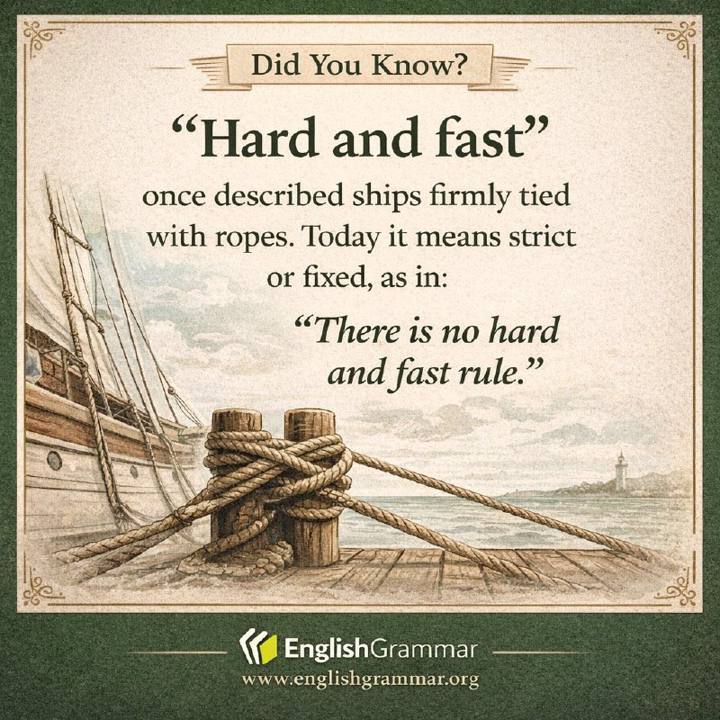
The phrase “hard and fast” has long been used to describe rules or standards that are strict and unchanging. Its origin comes from nautical terminology, where a ship that was “hard and fast” on shore was firmly stuck and immovable. Over time, this term began to be applied more broadly, eventually describing laws or boundaries that are absolute and clearly defined. Today, “hard and fast” retains this connotation, commonly referring to guidelines or decisions that allow for no exceptions. 🏴 Our channels
A comprehensive guide to mastering English grammar has been released. This resource covers essential topics including parts of speech, verb tenses, and sentence structure. It is designed for learners at various levels, offering clear explanations and practical examples. The guide aims to support both independent study and classroom learning. Readers will find it useful for improving their language proficiency. 🏴 Our channels
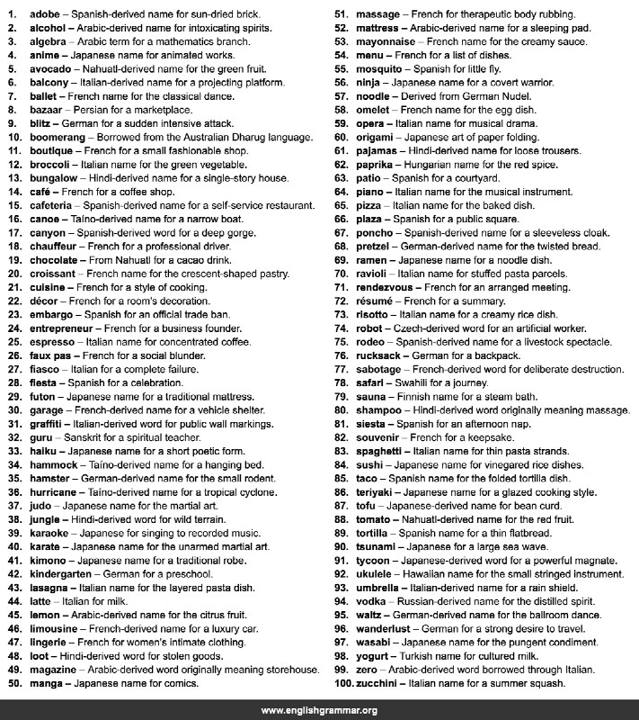
A new compilation highlights 100 commonly used English words that have origins in a wide variety of languages worldwide. The list demonstrates how English has adopted vocabulary from numerous sources through history, reflecting its continual evolution. Each word on the list is part of everyday conversation, chosen for its regular appearance in modern English. This collection showcases the international influences that shape the language and illustrates English’s role as a global language with diverse roots. No promotional content is included, and the list can be used as a reference for language studies or general interest. 🏴 Our channels
The core event: The phrase “in the nick of time” once had a specific historical meaning. Originally, “in the nick of time” referred to a critical, exact moment. The “nick” meant a precise mark or notch, used to record or measure something important at a particular point. Over time, the phrase evolved, becoming associated with something happening at the last possible instant. The original use focused on accuracy and timing, rather than urgency. 🏴 Our channels
Enquire and inquire: differences in usage The terms “enquire” and “inquire” are often interchangeable, but there are regional preferences and subtle distinctions. In British English, “enquire” is usually used for general questions, while “inquire” often relates to formal investigations. In American English, “inquire” is favored in both contexts, and “enquire” is rarely used. Both verbs stem from the same Latin root and can refer to asking for information. Their noun forms are “enquiry” and “inquiry,” which follow similar usage patterns. The choice between them typically depends on regional spelling conventions and the formality of the situation. 🏴 Our channels
🏴 Our channels
🏴 Our channels
The phrase “in the long run” describes the idea of considering outcomes or effects over an extended period, rather than focusing on immediate results. This expression traces its roots to economic and philosophical discussions, where it is used to emphasize patience and the eventual consequences of actions or policies. Historically, the phrase gained prominence in the context of economic theory, often attributed to analyses involving time, growth, and market behavior. Its continued use highlights the importance of evaluating decisions with a long-term perspective rather than relying solely on short-term impacts. 🏴 Our channels
Correct usage of “at,” “on,” and “in” for time and place The prepositions “at,” “on,” and “in” have specific uses when referring to time and location. “At” is typically used for precise times or specific places. Examples: at 5 p.m., at the door. “On” applies to days and dates, as well as surfaces. Examples: on Monday, on the table. “In” is used with months, years, longer periods, and enclosed spaces. Examples: in July, in 2024, in the kitchen. Understanding these distinctions ensures clear and accurate communication. 🏴 Our channels
🏴 Our channels
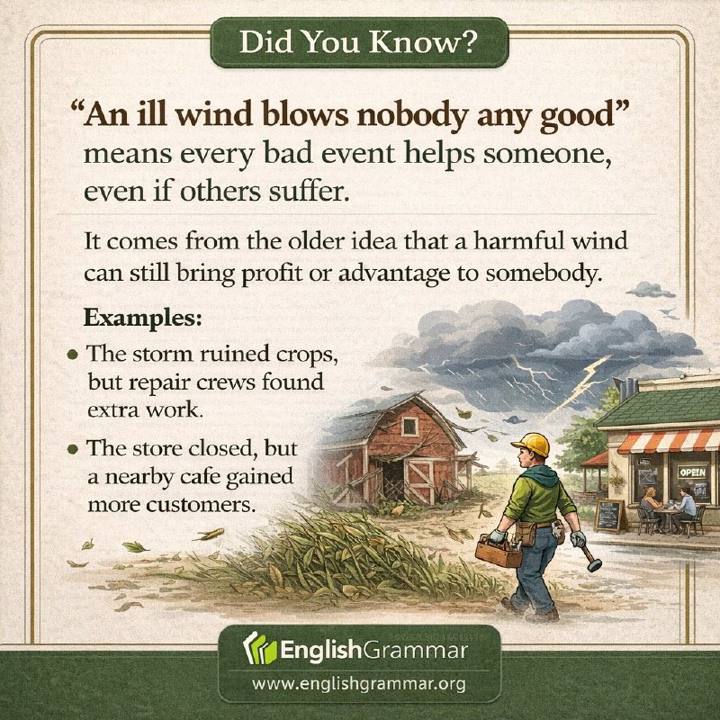
The phrase “an ill wind blows nobody any good” refers to the idea that even negative events can sometimes have positive outcomes for someone. Historically, this English proverb dates back several centuries and appears in various forms throughout literature. Its meaning centers on the notion that circumstances harmful to many may still be advantageous to a few. The origin of the phrase can be traced to early English writings, where it was used to reflect life's complexities and the unexpected benefits that can arise from misfortune. This saying continues to be cited as an example of ironic wisdom in English language usage. 🏴 Our channels
A preposition is a part of speech that indicates the relationship between words in a sentence. It typically shows direction, location, time, or method. Common examples include “in,” “on,” “at,” “by,” “with,” and “about.” Prepositions are often followed by a noun or pronoun to complete the phrase. Accurate use of prepositions ensures clarity and coherence in written and spoken English. 🏴 Our channels
🏴 Our channels
The phrase "in the black" is used to indicate that a business or organization is profitable. This expression dates back to times when accountants used black ink to record positive financial results, distinguishing them from losses, which were marked in red ink. Being "in the black" means earning more than is spent, resulting in a profit on financial statements. It is a common term in financial reporting and business discussions. 🏴 Our channels
🏴 Our channels
Plane vs. plain: the distinction explained A “plane” refers to an aircraft or a geometric concept describing a flat surface. In contrast, “plain” describes something simple, unadorned, or can refer to a flat area of land. These two words sound the same but carry different meanings and uses. Understanding the difference is essential to ensure accurate communication and prevent confusion between these commonly misused terms. 🏴 Our channels
Formidable and formative are two distinct adjectives frequently confused in English usage. Formidable describes something that inspires fear, respect, or awe due to its size, strength, or difficulty. For example, a "formidable opponent" is one that appears tough to defeat. Formative refers to something that shapes, influences, or helps in the development of a person or thing, such as a "formative experience" during early childhood. The two words carry different meanings and are not interchangeable in formal or casual contexts. Clear understanding of these terms can help avoid common language errors. 🏴 Our channels